
Why SMEs May Need Fractional FD Support Before They Think They Can Afford It
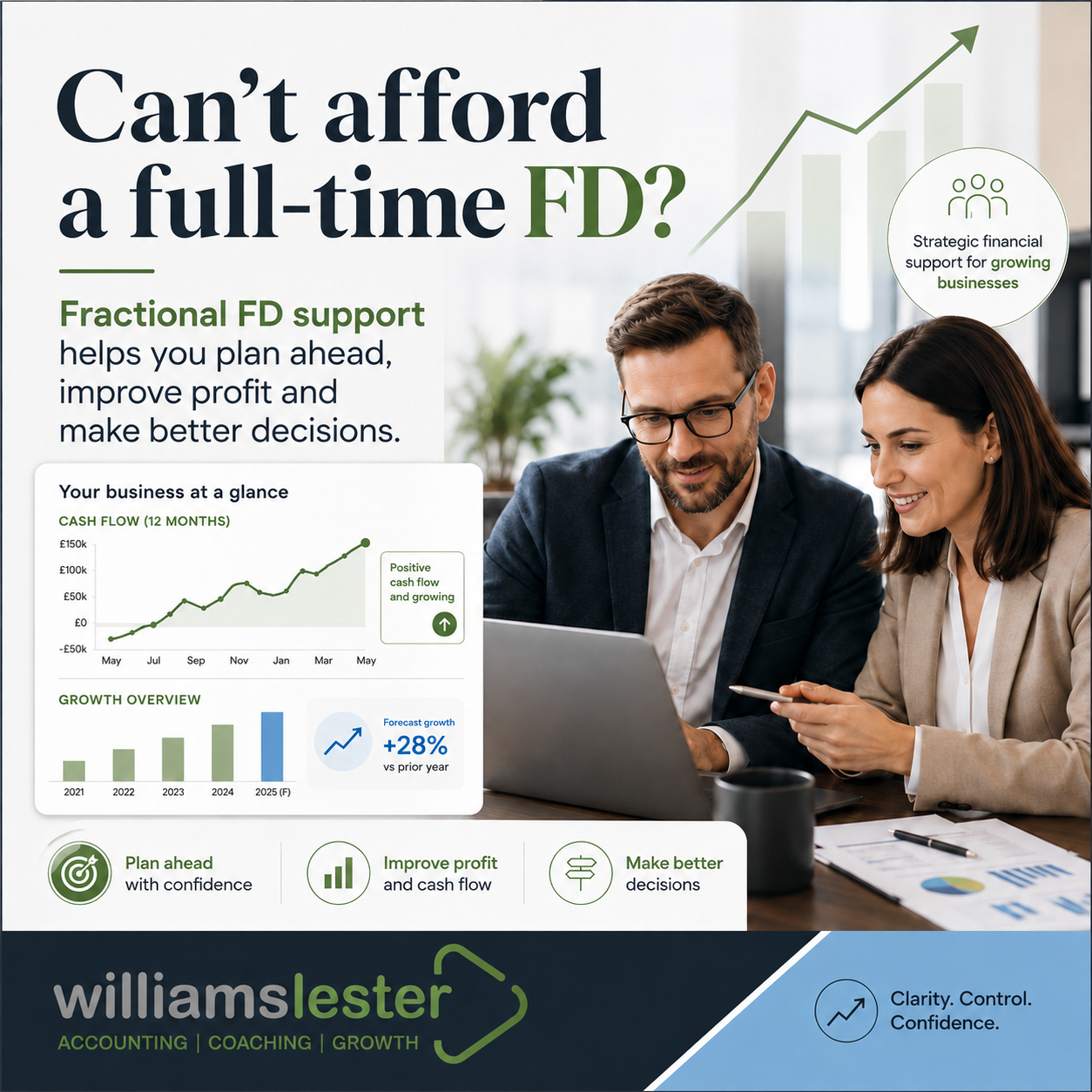
Many business owners say the same thing:
“I can’t afford a fractional FD.”
And in many cases, they are right — at least in the traditional sense.
Most small and medium-sized businesses do not need a full-time Finance Director sitting in the business every day. They may not have the size, complexity or budget to justify a senior finance professional on the payroll.
But that does not mean they can afford to run the business without proper financial guidance.
In fact, for many growing businesses, the more important question is not:
“Can I afford fractional FD support?”
It is:
“Can I afford to keep making important decisions without it?”
Your accountant is not automatically your fractional FD
A good accountant is extremely valuable. They help keep the business compliant, prepare accounts, deal with tax returns, advise on tax planning and make sure deadlines are met.
A good bookkeeper is also valuable. They help keep records up to date, process transactions, reconcile the bank and maintain accurate financial information.
But bookkeeping, compliance and financial strategy are not the same thing.
A business may have clean bookkeeping and filed accounts but still be making decisions without really understanding its numbers.
That is where the gap often appears.
A fractional FD looks forward, not just backwards. They help business owners understand what the numbers mean, what the risks are, where the opportunities are, and what impact decisions may have on profit and cash flow.
The real cost of not having financial direction
The cost of poor financial decision-making can be significant.
One bad hire can create months of additional wage costs without the expected return.
One underpriced contract can keep the team busy while quietly damaging profit.
One expansion decision made too early can put pressure on cash flow.
One poorly planned investment can leave the business short of working capital.
One missed warning sign can turn a manageable problem into a serious one.
These issues can easily cost more than the advice that may have prevented them.
That is why fractional FD support should not be seen purely as a cost. Used properly, it should help protect the business, improve decision-making and support profitable growth.
What should fractional FD support actually do?
Proper fractional FD support should help a business owner answer practical questions such as:
What will our cash flow look like over the next 3, 6 and 12 months?
Which services, products or contracts are most profitable?
Are we charging enough?
Can we afford to recruit?
What happens to cash flow if sales increase?
How much profit are we really making?
Are overheads growing faster than the business?
What funding might we need?
What numbers should we be reviewing each month?
What needs to change to improve profit?
This is very different from simply receiving accounts months after the year end.
Year-end accounts are important, but they are historic. They tell you what happened.
Fractional FD support should help you decide what happens next.
When does a business need this kind of support?
There is no single perfect point where every business suddenly needs fractional FD-level advice.
But there are clear signs that the business may have outgrown basic compliance support.
For example, fractional FD support becomes more important when a business is:
Taking on employees
Winning larger contracts
Expanding into new areas
Investing in equipment, premises or vehicles
Experiencing cash flow pressure
Growing quickly but not seeing profit improve
Preparing for finance, sale, succession or restructuring
Unsure which parts of the business are actually profitable
Making decisions based on bank balance rather than management information
At this stage, the business owner usually needs more than accounts and tax returns.
They need useful financial information, regular conversations and someone willing to challenge decisions based on the numbers.
Financial thinking should be involved before decisions are made
One of the biggest problems in many businesses is that financial information arrives too late.
The business owner makes the decision, commits to the cost, agrees the price, hires the person or signs the contract.
Then the accounts are prepared afterwards.
That is the wrong way round.
The businesses that grow well usually bring financial thinking into the decision-making process before action is taken.
They use forecasts, management accounts, profit analysis and cash flow planning to make better decisions in real time.
This does not remove risk completely, but it does mean decisions are made with far better information.
Fractional FD support does not have to mean a full-time Finance Director
For many SMEs, the answer is not employing a full-time Finance Director.
The answer is having access to Finance Director-level thinking in a flexible and affordable way.
This is often called fractional FD, Virtual FD or outsourced finance director support.
The name matters less than the result.
The real value is having someone who can help you understand your numbers, challenge assumptions, plan ahead and improve the financial performance of the business.
How williams lester accountants can help
At williams lester accountants, we work with business owners who want more than basic compliance.
We help businesses understand their numbers, improve profitability, plan for growth and make better decisions.
That may include management accounts, cash flow forecasting, budgeting, pricing reviews, profit improvement, tax planning, business mentoring and Virtual FD-style support.
For many growing SMEs, this type of advice is not a luxury.
It is the difference between reacting to problems and planning properly.
It is the difference between guessing and knowing.
And it is often the difference between growth that looks good on paper and growth that actually produces profit.